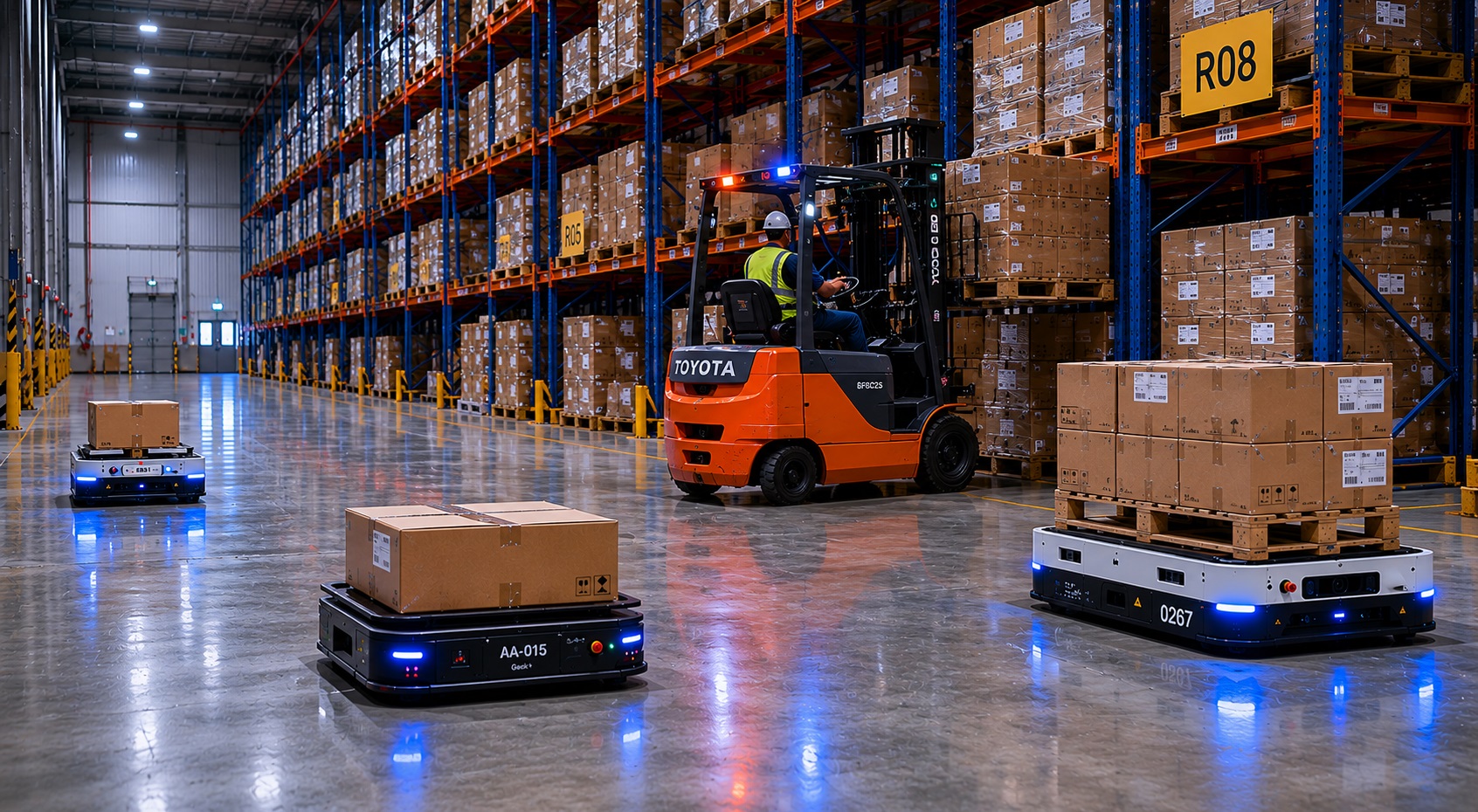
The problem nobody talks about: vehicles sharing space
Fleet sizing studies almost always focus on one vehicle type at a time. How many AGVs do we need? How many AMRs? How many forklifts for the manual zones? Each question gets answered in isolation — by the vendor, by a spreadsheet, or by rough calculation.
The result is a facility where each fleet was sized correctly on paper, but in practice the vehicles interfere with each other constantly. An AGV on a fixed route blocks an AMR that needs to reroute. A forklift taking a wide turn at the loading dock creates a recurring queue for three AGVs waiting to charge. None of this shows up in a single-vehicle calculation.
The core problem: Intralogistics is a shared-space system. The throughput of each vehicle type depends on what all the others are doing. Sizing them separately guarantees the combined result is wrong.
Three vehicle types, three different modelling challenges
AGV
Follows predefined routes — magnetic tape, QR codes, or wire. The simulation models traffic contention on fixed paths, charging cycles, and intersection priority rules. The critical question: where does the route network create deadlocks under load?
AMR
Navigates freely using SLAM — no fixed paths, reroutes around obstacles in real time. The simulation models fleet coordination via the traffic management system, zone reservations, and the interaction between dynamic AMR routing and the fixed infrastructure AGVs rely on.
Forklift
The unpredictable agents in any intralogistics model. Variable speed, unplanned stops, operator behaviour patterns, and shift breaks all affect how much space automated vehicles have. A model without forklifts will overestimate automated throughput by a significant margin in mixed facilities.
How simulation handles the whole picture
A Simio simulation model places all vehicle types in the same environment simultaneously. Each AGV follows its routing logic, each AMR navigates dynamically, each forklift moves according to its task list and operator behaviour parameters. They share aisles, intersections, charging infrastructure, and loading docks — and the model captures every interaction.
This means you can test questions no spreadsheet can answer: What happens to AGV throughput when forklift shift patterns change? Does switching from 12 AGVs to 8 AMRs maintain throughput — and what does the aisle conflict profile look like? Can three more forklifts replace two broken AGVs during peak season without throughput collapse?
Fleet inventory & layout mapping
We document every vehicle type in scope: AGV specifications (speed, payload, charging), AMR navigation system and fleet management software, forklift types and task profiles. The floor plan is mapped including shared zones, charging locations, and pedestrian areas.
Mixed-fleet model build
We build the Simio model with all vehicle types operating together. AGV fixed routes, AMR dynamic navigation logic, and forklift task models are validated separately, then combined with the shared traffic management layer.
Scenario matrix
We test the configurations you need to compare: different fleet compositions (more AMRs, fewer AGVs), routing rule changes, charging strategies, shift pattern variations, and peak demand events. Typically 5–8 scenarios with multiple replications each.
Results & fleet recommendation
You receive throughput curves for each scenario, conflict and queue analysis by vehicle type, a specific fleet composition recommendation, and the Simio model — yours to rerun as requirements change.
What you get at the end
Deliverables include: the Simio model file, a scenario comparison report with throughput and utilisation curves for each vehicle type, an aisle conflict analysis, and a written recommendation. If your plans change after delivery — new vehicle specs, revised throughput targets, a layout change — the model reruns.
AGV vs AMR vs forklift — what the model captures
| Model element | AGV | AMR | Forklift |
|---|---|---|---|
| Navigation behaviour | Fixed route + traffic rules | Dynamic SLAM pathfinding | Task-driven, variable |
| Charging / energy model | Scheduled or opportunity charging | Opportunity charging at docks | Shift-based refuelling |
| Fleet coordination | Central dispatcher logic | TMS zone reservations | Manual coordination |
| Interference with other types | Modelled at every intersection | Dynamic avoidance simulated | Variable obstruction modelled |
| Failure / downtime | MTBF/MTTR distributions | MTBF/MTTR distributions | Operator absence, breaks |
What data do we need?
The more you have, the more precise the result — but we can start with design targets and known vehicle specs:
- Floor plan or CAD layout — with aisle widths, turning radii constraints, shared zones marked
- Vehicle specifications — speed, payload, turning radius, charging time for each vehicle type
- Task profiles — what each vehicle type does, how many trips per shift, pick/drop locations
- Forklift shift patterns — number of operators, shift start/end, break schedules
- Throughput targets — pallets per hour, orders per shift, or transport tasks per hour
- AMR traffic management system — vendor and version if already selected; if not, we model a representative TMS
Tools & technology
All fleet simulation work is built in Simio, using our proprietary intralogistics framework — pre-validated components for AGV fixed-path routing, AMR dynamic navigation modelling, forklift task logic, shared intersection management, and multi-type charging coordination. For fleet composition optimisation problems with multiple simultaneous constraints, we layer in IBM Decision Optimization.
We model all major AGV vendors (Jungheinrich, Still, Dematic, SSI Schäfer, and others), AMR platforms (Mobile Industrial Robots, Locus, Fetch, Geek+), and standard forklift types. Vendor-specific behaviour can be parameterised directly from the technical datasheet — no vendor plugin required.
See it in practice
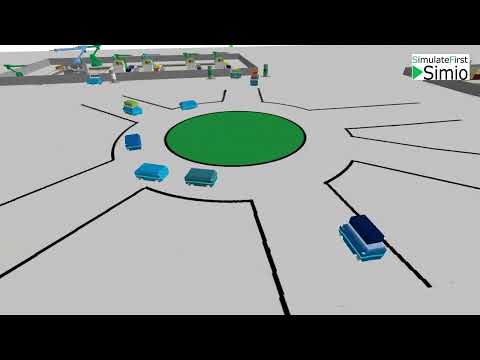
E-commerce warehouse — AGV & ASRS fleet sizing
Simio · Logistics
Manufacturing plant — AGV & forklift coexistence study
Simio · Manufacturing
